Kuma Labs
2024-2025 · Growth
- Client
- Kuma Labs
- Role
- Chief Marketing Officer (CMO)
- Outcome
- 71,000 downloads at R$ 0.17 each
- Link
- kumalabs.co
Summary
Kuma Labs is a studio that creates mobile games and brings other companies' games to market as a publisher. I joined as CMO when the company had no marketing yet.
- Problem: the company had a business plan and development and art teams, but no one to bring the brand and the games to market.
- What I did: I built the brand, the social channels, paid media, landing pages, email marketing and the Discord from scratch. I led a team of five.
- Result: 71,000 Polybots Rumble downloads through Google Ads, at R$ 0.17 each (about US$ 0.03).
- Stack: Meta Ads, Google Ads, GreatPages, WordPress, Brevo, Discord and ClickUp.
- Background: my work as CMO of Kuma Labs, from 2024 to 2025.
Full case
7 min read
Context
In May 2024, the CEO of Kuma Labs invited me to build the company's marketing.
Kuma Labs creates its own mobile games. It also works as a publisher, bringing games from other companies and indie devs to market.
When I joined, the company already had a business plan, a development team, an art team and the plan for its first game.
But there was no marketing.
It needed someone to present the brand to the market and take each game to the player.
What I did
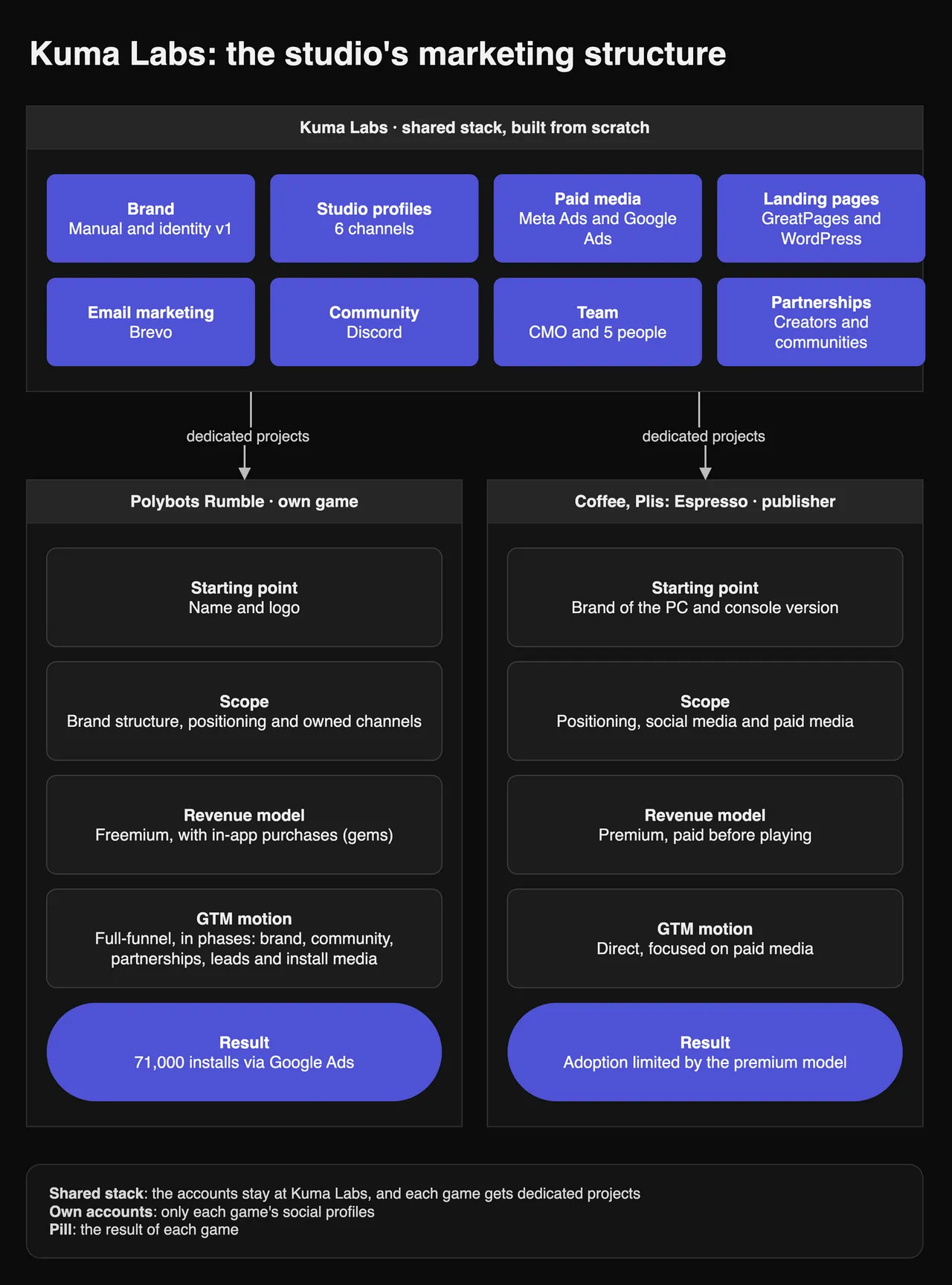
I joined as Chief Marketing Officer (CMO) and built the marketing base from scratch, for the studio and for each game.
The order was always the same: first the studio's brand structure, then the go-to-market of each game, with its own channels connected to the studio's.
The Kuma Labs brand
I created the brand manual and the first version of the studio's visual identity.
I opened and organized the Kuma Labs profiles: Instagram, X, TikTok, YouTube, LinkedIn and Facebook.
I set up paid media from scratch, on Meta Ads and Google Ads.
Before, every new page depended on the development team, which was already busy with the game's own demands.
To solve that, I set up a landing page structure on GreatPages and WordPress. The marketing team started creating its own pages, and in the phase before launch they captured leads.
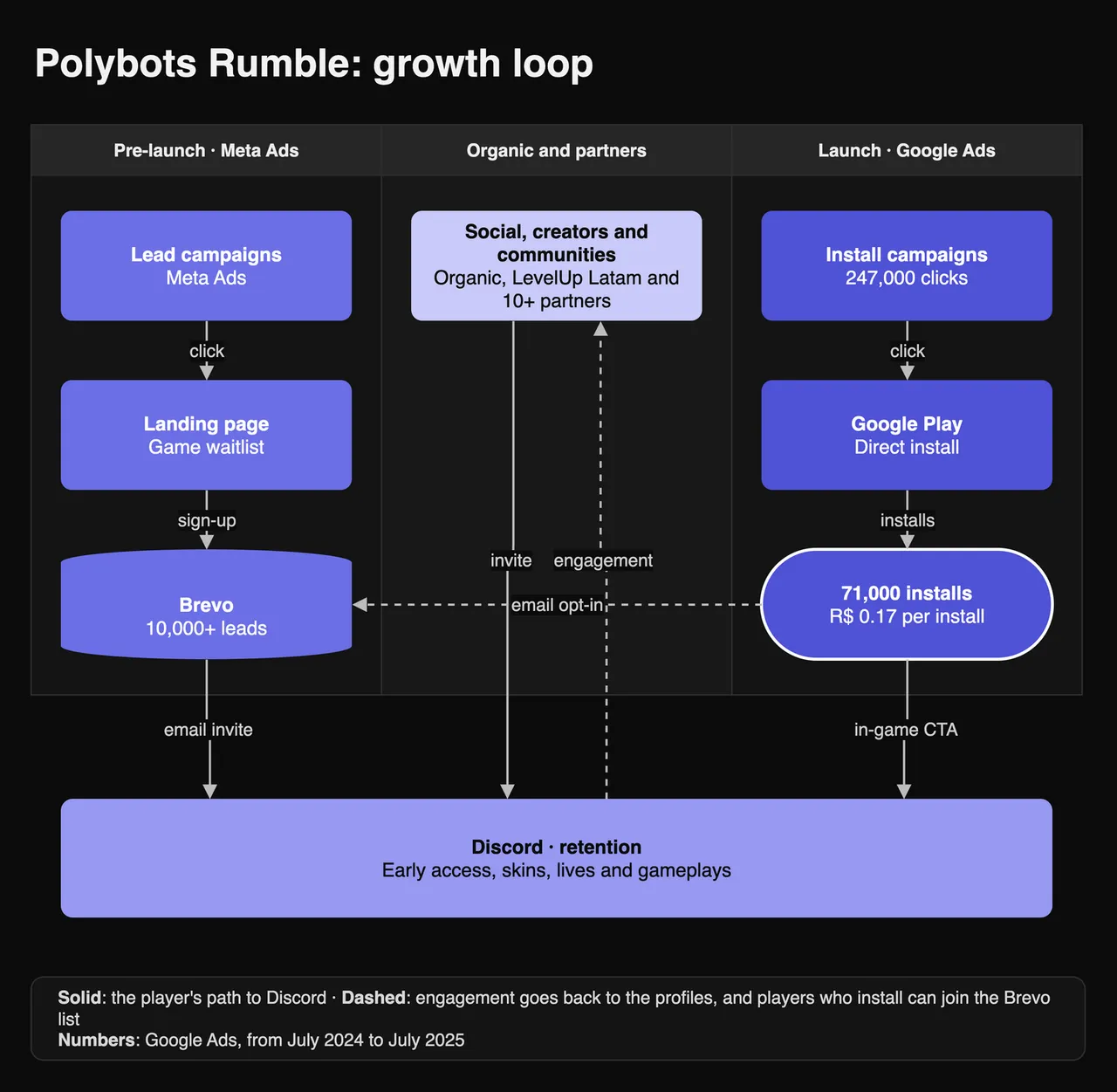
Leads went into email marketing, which I set up on Brevo to build a relationship until the game reached Google Play and the App Store.
I also closed a partnership with LevelUp Latam, which coordinated the creators of the YouTube videos.
We told them what we wanted and which creators we wanted. Together with LevelUp, we defined the style of the videos and what each creator would present.
In parallel, I planned collabs with other gaming communities.
The Discord community
I built the Discord server from scratch, as the home of the community for every game.
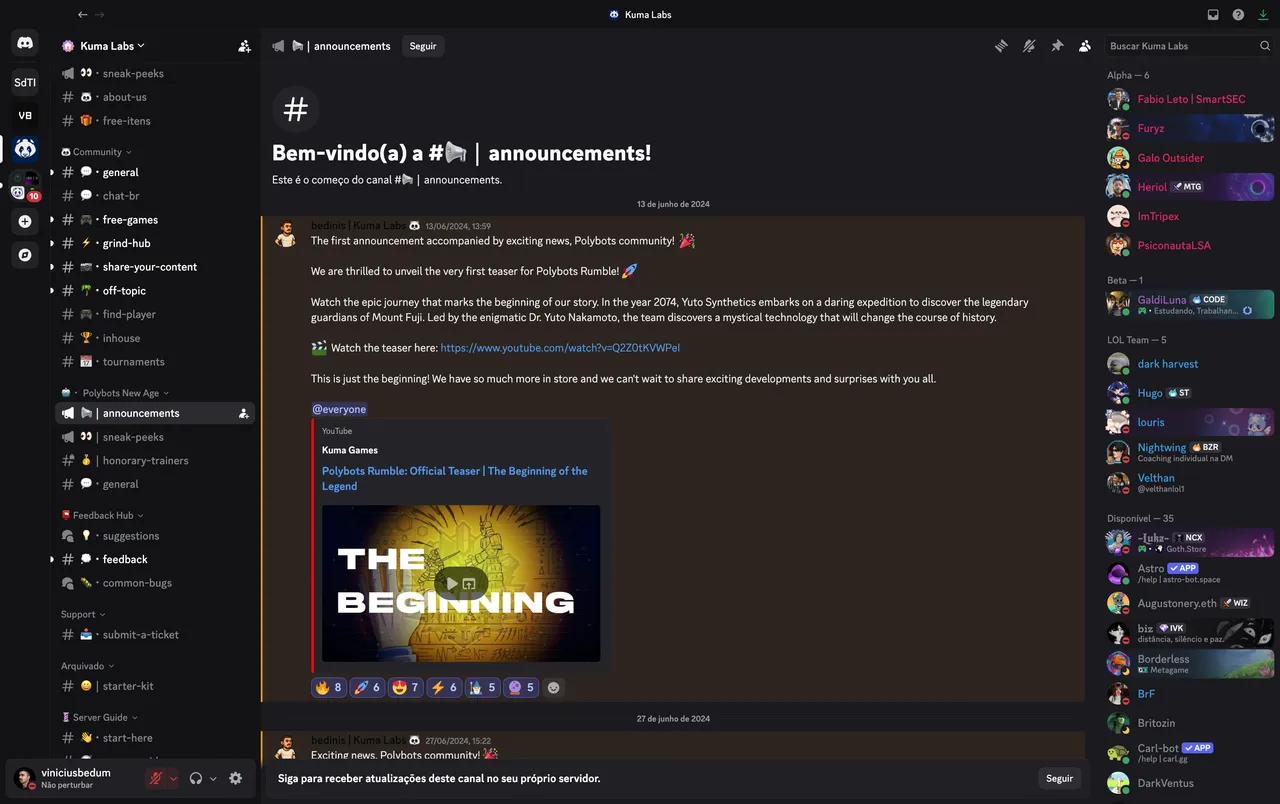
The server had studio channels and separate channels for each game. A general community lived alongside smaller communities in the same space.
The most engaged members got special access, exclusive skins and early access.
Lives and gameplays with our streamer kept the server active between one launch and the next. '
Polybots Rumble
Polybots Rumble was the first game created by Kuma Labs. It was a turn-based battle mobile game, on the freemium model: downloading was free, and players could buy gems to get skins, characters and advantages.
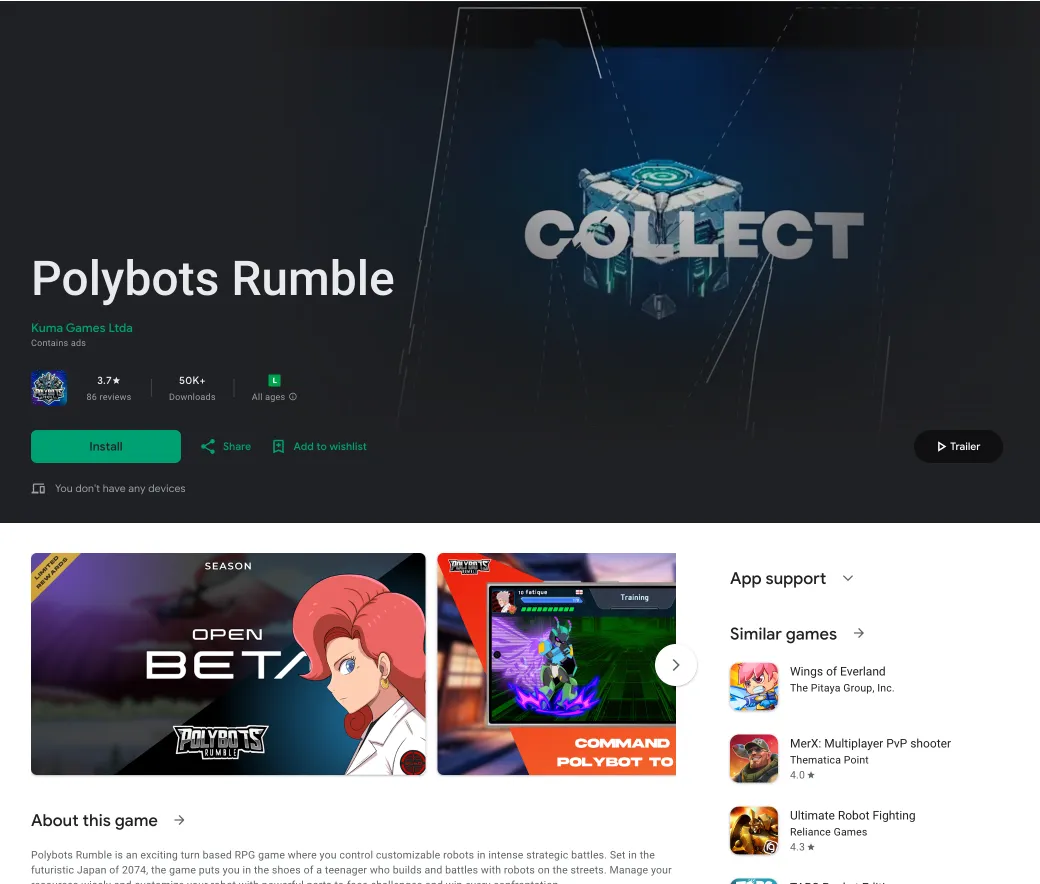
Google Play shows downloads in tiers. "50K+" covers any number from 50,000 to 99,999, until the game reaches the 100K+ tier. The Google Ads dashboard, in the Result, shows the exact number.
When I joined, the game had only its name and logo. From there, I built the whole brand structure and positioning, with the same reasoning used for the studio.
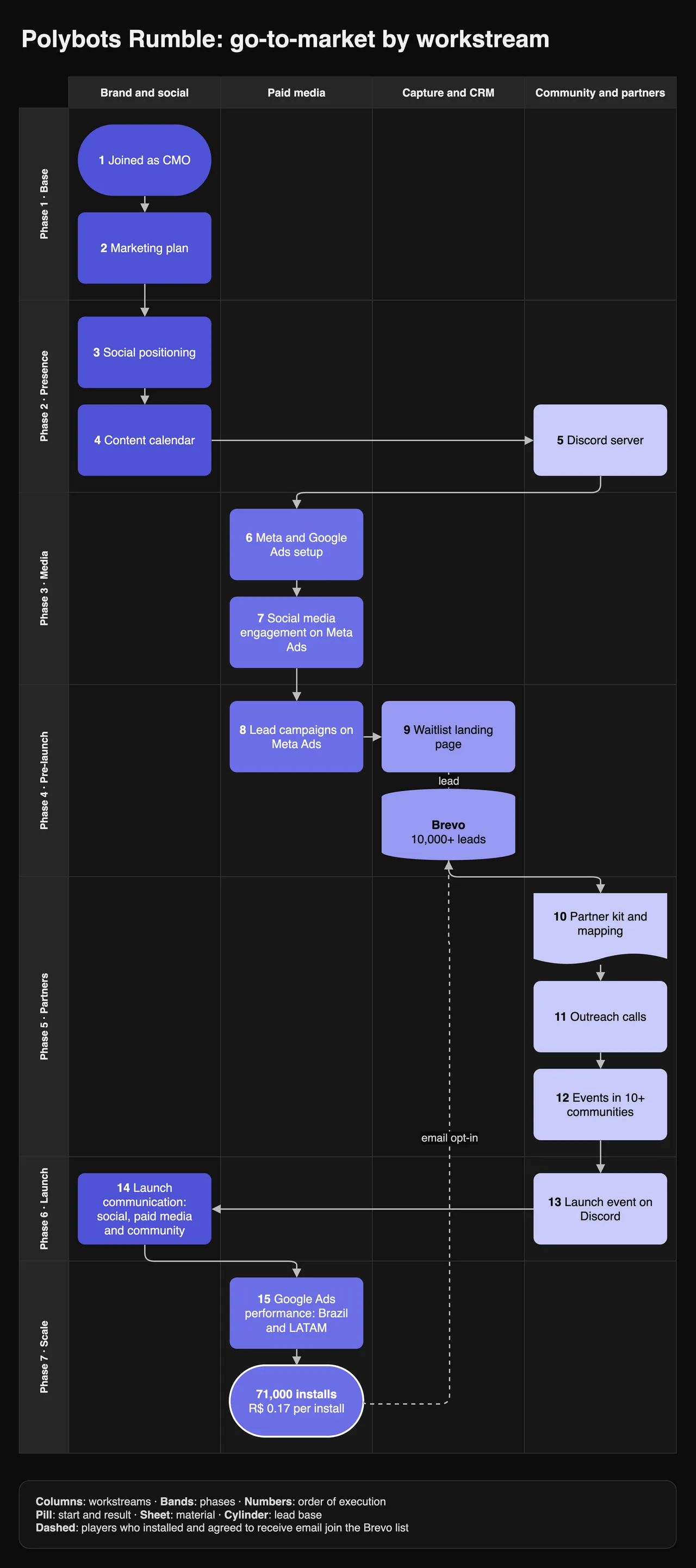
I created the game's profiles, the post calendar and the campaigns on Google Ads and Meta Ads.
Some ads ran on the Kuma Labs and the Polybots Rumble profiles at the same time, depending on the strategy of each campaign.
The profiles led to the landing pages, to Discord and to the game download.
Email marketing got a channel and an automation just for Polybots Rumble leads. The list passed 10,000 emails.
For the launch, I closed partnerships with gaming and web3 communities. The most engaged community would get a character and a trainer inside the game, created by its members.
The Nest DAO won. Its symbol is an owl, so the robot got an owl-inspired look and attacks. Watch the teaser ↗
Coffee, Plis: Espresso
Coffee, Plis: Espresso was created by two brothers, indie developers, for computer, on Steam, and for consoles such as Nintendo Switch, Xbox and PlayStation.
They came to Kuma Labs to adapt the game to mobile and bring it to Google Play and the App Store. In this case, we worked as the publisher.
The game already came with the brand of its computer version. I kept it and built what was missing: the positioning, the social profiles and the Meta Ads and Google Ads setup.
The game followed the premium model, where the player pays once before playing. That model limited adoption at scale.
The team
I led a team of five, between employees and freelancers:
- a community manager for Discord;
- a streamer, who also created content for the social profiles;
- a 3D artist;
- two freelancers for assets and motion.
I was the direct link with the development team and other leaders in the company, negotiating priorities between the areas.
Tasks were organized in ClickUp. Creatives and videos came out of Canva, Photoshop and CapCut.
Result
Between July 2024 and July 2025, the Polybots Rumble campaigns on Google Ads added up to 71,000 downloads and 247,000 clicks.
Each download cost R$ 0.17 on average (about US$ 0.03), and the click-through rate was 3.11%.
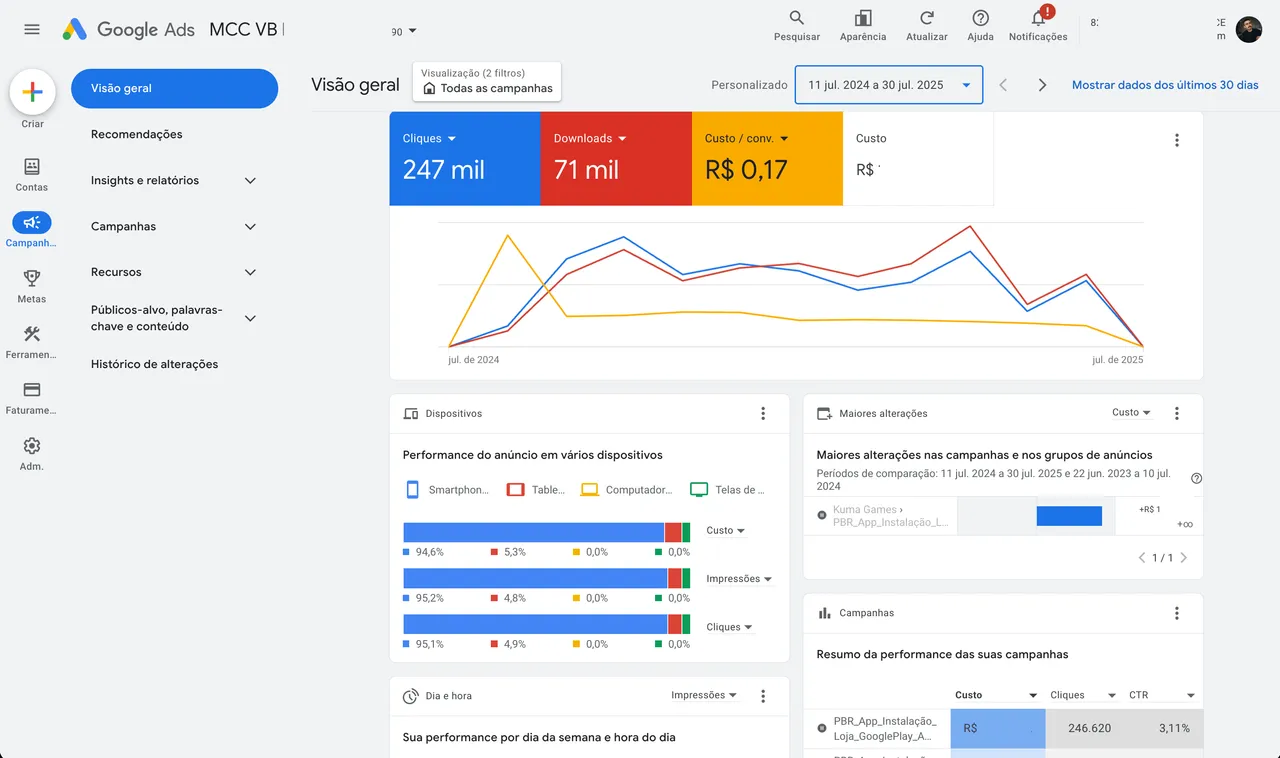
The campaigns stopped when the development team was restructured and the game's updates were suspended. Without that pause, growth could have been much larger.
Later, the game went past 100,000 downloads.
With a repositioning of the business, Polybots Rumble was discontinued to make way for a new version, called Polybots New Age. It trades turn-based combat for faster, more frantic gameplay.
Polybots New Age is expected to reach the market from November 2026.
That result gave Kuma Labs its first case to show other companies and devs looking for a publisher.
In September 2025, I asked to step out of operations.
Kuma Labs was already structured, and another project started to need more time than I could split between the two.
I gave notice well in advance and handed over calmly, with several calls and recorded video lessons on each step of what I did.
I left operations with the marketing documented, a team in place and the studio's first game past 70,000 downloads.
Today I remain a partner and follow the company's direction passively.